


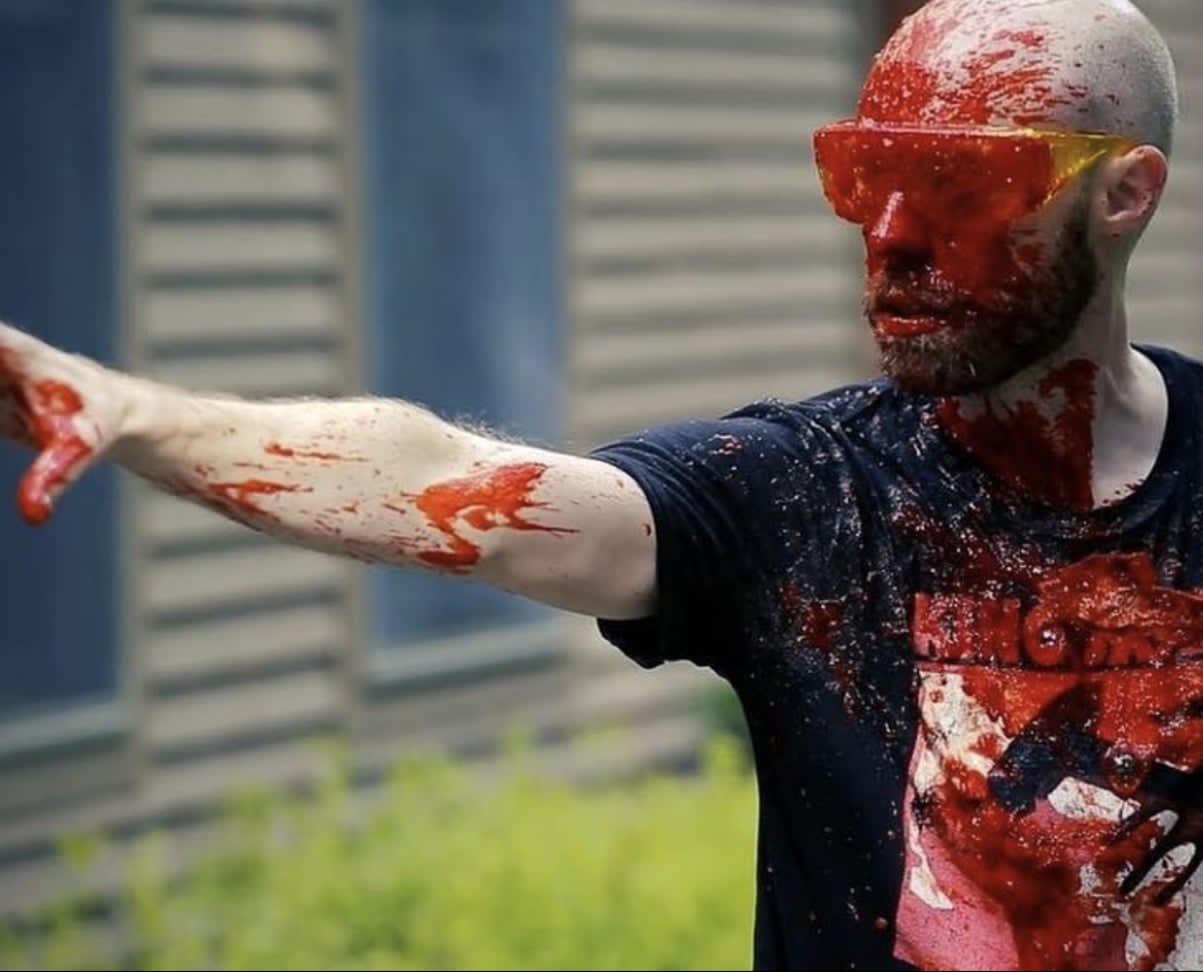
You know that feeling when you leave a movie theater after watching a film, and honestly can’t tell whether you loved or hated it? All you know is you can’t stop thinking about it, and it sticks in your head waiting for you to formulate an opinion. That was my experience with Joel Potrykus’s Buzzard. Well, kind of.
At the time (2014) I had just recently interviewed the Michigan-based director for a local entertainment guide. The interview stoked my curiosity, and I figured I owed it to him to check out one of his films myself. I went to a screening at an art theater in Grand Rapids and left utterly confused. Was this supposed to be a goofy slacker film, or a serious exploration of a troubled scammer’s inner psyche? Was this made by a group of friends for their own enjoyment, or was it a more professional endeavor? Was it highbrow art, or lowbrow entertainment?
The honest answer is a little bit of everything above. Throughout the years I followed his film career, interviewing Potrykus from time to time when he released a new film. With every subsequent movie I became more interested and began to understand his quirks and artistic inclinations. After watching his most recent film, 2024’s Vulcanizadora, I became a full-blown convert. When I recently saw that four out of five of Potrykus’s feature films (Buzzard, Relaxer, Alchemist Cookbook, and Vulcanizadora) were streaming on Shudder, it felt like a good excuse to catch up with him.
“I was really curious on this Shudder run how people would react, and if they would be bugged that there’s no, you know, slashers or ghosts or whatever,” Potrykus told Cinepunx. It makes sense he would be curious given that his movies aren’t really horror movies. The Alchemist Cookbook, a movie about a recluse living with his cat in a trailer in the woods while he attempts to learn alchemy, is probably the closest thing to a horror movie, though certainly not in a conventional sense. It ends up feeling more like a character study of someone struggling with mental illness, and is described by Potrykus himself as being closer to slow cinema rather than standard horror fare.

While it’s incredibly difficult to label the types of movies he makes, that doesn’t stop people from trying. Some genres that have been attributed to his movies are “midwestern gothic,” “metal slackerism,” and “cinema of nervousness.” Potrykus isn’t really concerned about any of his movies fitting neatly into any one genre though.
“The tone is one of the most important things for me,” Potrykus says. “I’m always trying to find the balance between funny, sad, and scary […] I just want to keep the audience off balance and uncomfortable.”
All of Potrykus’s films feature this bizarre midwestern brand of nihilistic humor that grows on you over time. They’re populated with angry, emotionally-stunted antisocial male characters who make poor choices and live bleak lives. These characters dwell in parents’ basements, trailers in the woods, motel rooms and cheap apartments. They perform small-scale scams to get free Hot Pockets or an extra $50 for opening a new checking account. They like to play with fire (literally and figuratively), and can’t seem to figure out how to take any responsibility for anything. In short, the characters are messy and stuck in a state of permanent adolescence.
“I didn’t realize that these characters were so antisocial until people started reviewing them and talking about how kind of toxic and awful they are,” Potrykus said. “Weirdly, the older I get, the more I realize that I’m kind of one of my characters. That I really have a hard time in social settings, and sometimes just adapting to other adults.”
He says his favorite types of movie characters tend to be “prototypical Travis Bickle-type characters,” which he further goes on to describe as people who can’t connect, aren’t getting by easily, and just aren’t happy. At this point in his career writing such characters is essentially a form of therapy that he likens to holding a mirror up to himself to process his similarities. “Minus maybe the rabid nihilism, or you know, violent tendencies,” Potrykus clarified.

In addition to being known for their antisocial characters and propensity to defy genres, Potrykus’s films are also known for being shot on a microbudget. It seems fitting, given that so many of the characters themselves tend to be only a few slushies away from being totally broke. His first feature Ape, which follows a struggling stand-up comic as he seeks solace through acts of pyromania, was shot for only $3,000. While subsequent film budgets certainly increased, they still remained well within the tens of thousands. So far it’s the best way he’s found to avoid studio involvement and maintain complete creative control. What he lacks in funds he makes up for by utilizing guerilla filmmaking techniques, like shooting without permits, buying used equipment only to sell it back on eBay immediately after filming, having local actors take side roles, etc. He also saves money by working with a small-but-dedicated crew of collaborators he’s picked up over the years.
“My goal when I started off was to make a sort of film band,” Potrykus explained. “Every new film we make we just kind of add a couple new members to the band, and we just keep building. So at this point it’s been the same cinematographer, art director, sound operator, assistant director, producer for… since I don’t know when.”
His surreal 2018 Y2K slacker comedy Relaxer is on the higher end of budgets he’s worked with so far. It follows the protagonist Abbie as his older brother subjects him to humiliating, impossible challenges, all while the horrors of Y2K loom in the near future. While it cost more money than Potrykus is perhaps used to working with, its budget was still well under $100,000, which required a decent amount of penny-pinching to make it work. For instance, the sole location of the film is a bedroom set that was built over several months by Potrykus and Production Designer Mike Saunders in Saunders’s parents’ garage.
The bigger budget did, however, give him the chance to work with collaborators outside of his usual crew. Instead of his usual reliance on local underground metal and hip hop, the budget helped fund a score by Neon Indian. It also provided him the chance to bring on David Dastmalchian in a supporting role. In a way, that opportunity provided him even more of a challenge.
“Working with somebody from out of town like Dave Dastmalchian, it’s tricky because I don’t know his rhythms or how he likes to work, so that takes a while to kind of ease into it,” Potrykus explained. “Any actor that I’m working with, I like to know them pretty well.”

One actor that Potrykus knows very well is Joshua Burge. Given that Potrykus describes his core crew as film band, it’s fitting that his first introduction to the actor was through Burge’s band Chance Jones. They quickly became friends and shortly after filmed the 2010 short film Coyote. Since then Burge has starred in 4 of Potrykus’s 5 feature films. Over that time they’ve fostered a relationship that allows them to improvise whenever recurring characters Derek and Marty share the screen. In Vulcanizadora specifically Potrykus estimates the scenes with Derek and Marty are roughly 50% scripted and 50% improvised.
“Josh is just so good at taking something and going with it, and he never breaks character,” Potrykus explained. “So half of my goal when I’m improvising is can I make Josh laugh on this take? And he never laughs, he never loses it.”
If I were to suggest one specific movie to introduce someone to Potrykus’s oeuvre, it would have to be his most recent film from , Vulcanizadora. It’s a loose sequel to 2014’s Buzzard, which introduced audiences to the mismatched, tumultuous friendship between characters Derek Skiba (Potrykus) and Marty Jackitansky (Burge). Vulcanizadora follows up with these friends 10 years later as they embark on a journey deep into the Michigan forest with intentions only slowly revealed to the audience throughout the first half of the movie. What starts out like an odd version of a buddy comedy abruptly shifts into something much more grim around the midway point. The resultant tonal shift is shocking and incredibly effective. Vulcanizadora is the first movie Potrykus has directed since having a child, which plays heavily into the movie’s themes.
“[It’s] about all the fears that I didn’t realize I had until I had a kid,” Potrykus explained. “It wasn’t me losing my kid or my kid dying, but it was the opposite – him losing me, that was my biggest fear.”
In his mind, there were three specific scenarios that could lead to his fear becoming a reality. The first was going to jail for some dumb mistake; the second was losing his child to a messy divorce; and the third fear was dying in a freak accident. Each of these fears show up in the film in one form or another in ways that are vital to the overall dark tone. In addition, he cast his own son in a small but vital role, which adds to the emotional intensity of the film.
Potrykus hinted that this could be the last feature-length film he makes. This should perhaps be taken with a grain of salt though, considering he tends to say this after every movie he makes. He has also admitted that he has currently been busy writing a project he really likes. If that project does end up reaching the development stage though, it won’t be for a good while.
“Maybe the next three or four years I’ll be back on set to make another feature, but I’m in no rush,” Potrykus said. “I just really love Vulcanizadora, and I’m still just enjoying having made the kind of film that I’ve been trying to make for so many years.
Nowadays Potrykus teaches film at Grand Valley State University, near his hometown of Grand Rapids, Michigan. It’s not something he would have ever seen himself doing until after an on-campus screening of Buzzard. He was approached about being a guest teacher for a semester, which he accepted. Shortly after Potrykus got his masters degree and hopped on as full-time faculty at GVSU.
“Otherwise I was destined for a life very similar to the characters in my films,” Potrykus explained. “I was working as a temp at a mortgage company, a temp at a call service, a temp at a warehouse, a temp at a speaker factory, that’s just how I thought my life was going to be.”
While the temp work allowed him the freedom to quit when he needed to work on movies and tour his films at festivals, his current gig as a film professor gives him similar flexibility with much more job security. He now gets summers off to work on short films with his usual film crew, as well as the addition of some of his students.
“For the most part, they’re just part of the crew, but we do table reads of the script before we shoot, so they’re involved in the pre-production, and have influence over parts of the story, the casting, location, and wardrobe, all that,” Potrykus said. “I like to get their thoughts on it and get a different perspective from what does a 20 year old think about the way I make movies and tell stories, so it’s great.”
These short films also show a different side of his filmmaking. For instance, they often feature female leads, a departure from his angry antisocial male characters. It also draws inspiration from Věra Chytilová’s 1967 anarchic satire Daisies and has a touch more whimsy than his generally bleak features.
Potrykus has hinted that Oscilloscope will be putting out a future Blu-ray release of his collected short films, possibly next year. For those interested in getting of taste of them right now, Unemployees is currently streaming on the Criterion Channel, and will be joined by Buzzard and Vulcanizadora in July. Otherwise, as of right now, you can watch 4 of his 5 feature films on Shudder, or you can stream his first feature Ape on Tubi for free.


