


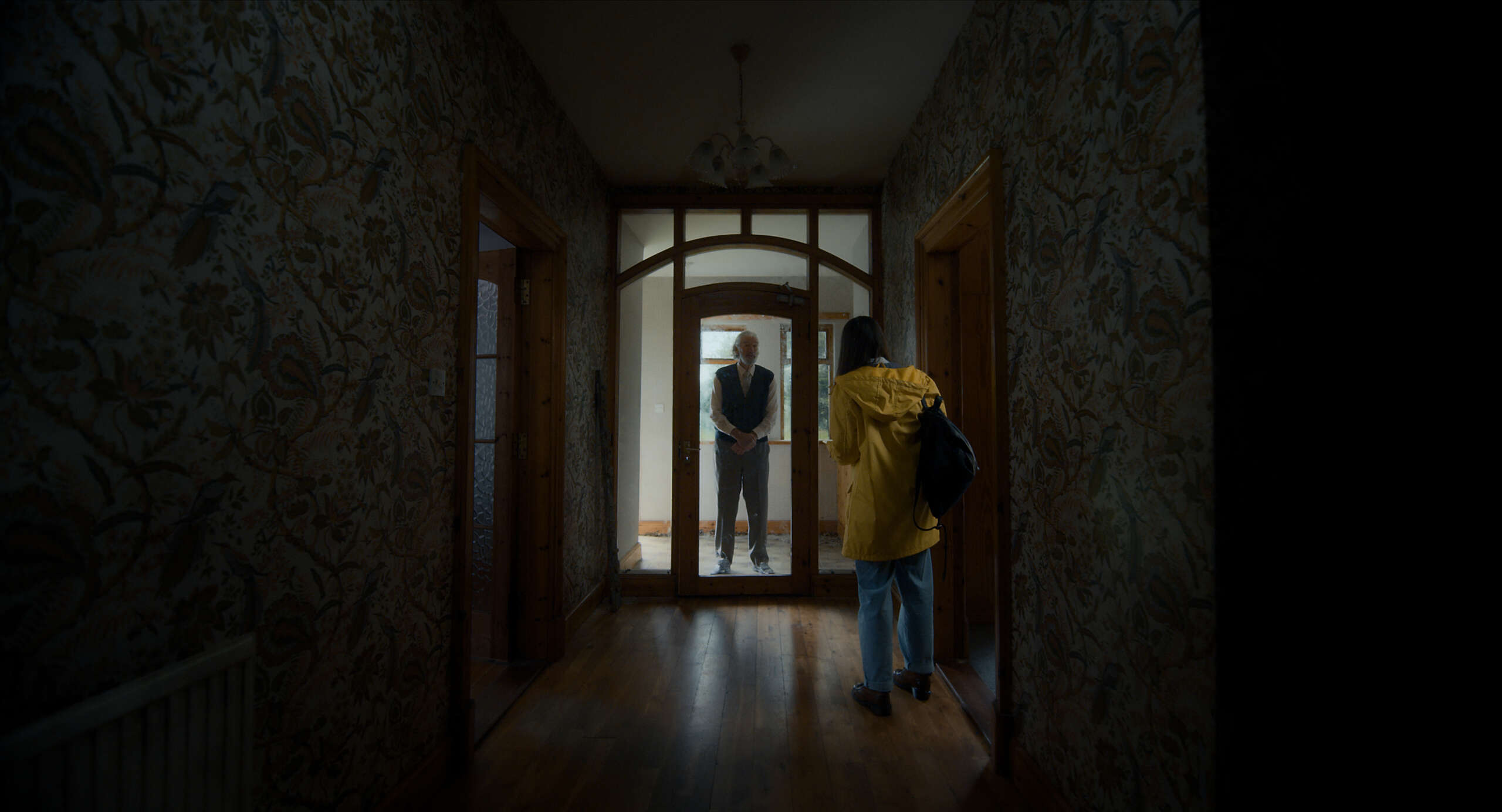
The concept of “liminal horror”, the exploration of spaces that are in a state of transition or decay, has gained quite a bit of traction in the last few years. Gavin Charles’ Noclip films made the festival circuit for the past two years, and who can forget the online furor and debate that erupted over Skinamarink? Harry Aspinwall’s The House Was Not Hungry Then takes a similar approach in evoking a sense of horror that these films do and couples it with a heavy dose of emotional symbolism that creates something far more melancholy than terrifying, all the while maintaining an eerie feeling of discontent.

Aspinwall’s set up is simple: there is a house in the Scottish countryside, a foreboding ancient hall, in which people simply…disappear. A sinister real estate agent is the man behind all of this, leading visitors in to their strange doom. One night, a girl breaks in seeking shelter, and thus the grim and despondent chain of events begins.

To address the five-hundred-pound gorilla in the room, if you are a person who is impatient with set up and requires constant action and exposition, skip this film. You will not like it. The House… is the definition of restraint, an exercise in technique. The film is almost entirely static shots of the interior of this house, something Aspinwall does to create a heavy, almost overwhelming sense of dread and anticipation. Lingering shots of rooms festooned with rotting wallpaper keep the eye darting from corner to corner, watching for any spectral intrusions. It relies very heavily on a sense of terror, an anticipation of the ghastly. In this, Aspinwall succeeds. Some will say ‘yeah but nothing is actually happening’, but I argue that the set up, and expectation of the horrible, is as emotionally taxing as actual horrific imagery. That is not to say nothing happens in this film, because plenty does, but the truth is oftentimes a film that seeks to unsettle through a creeping sense of dread is derided as “doing nothing”.

This film is, respectfully, kind of a bummer. I mean that in a good way. It’s been a minute since I’ve seen a movie that left me feeling as morose as The House… did. And I would argue that, since the goal of art is to evoke an emotional response in the consumer, it wholly succeeds. What makes this result all the more impressive is that while there isn’t a happy ending per se, by no means is it a sad movie tonally. But, somehow, the result is extremely sad. Perhaps this is a result of Aspinwall’s subtle commentary on the transitory nature of life, on the ritual of moving on and moving out, on acceptance and acquiescence. The end of innocence even. Either way, somehow, this film was deeply moving despite itself not moving much.

The House… won’t be for everyone. It refuses to hold the viewers hand and it asks for much in the way of patience, but it’s a spectacular example of how a powerful and moving story can be told in a rather simple way. It is doing a lot with very little, and the end result is much greater than the sum of its parts.


